
Undergoing a total knee replacement (TKR) is a life-changing milestone. For years, severe osteoarthritis may have shrunk your world—making a simple walk, a trip to the shops, or just getting up from a low chair feel incredibly daunting.
However, waking up after surgery brings a whole new set of challenges. The initial swelling, bruising, and stiffness can make you wonder if you’ve made the right decision.
As a physiotherapy team, we see patients at every stage of their post-operative journey. The literature is very clear: the surgery creates the opportunity for a pain-free life, but structured, progressive rehabilitation is what actually delivers it.
Here is what the latest orthopedic and physical therapy research says about navigating your recovery safely and effectively.
1. The Early Weeks: Managing the “Normal” Biological Response
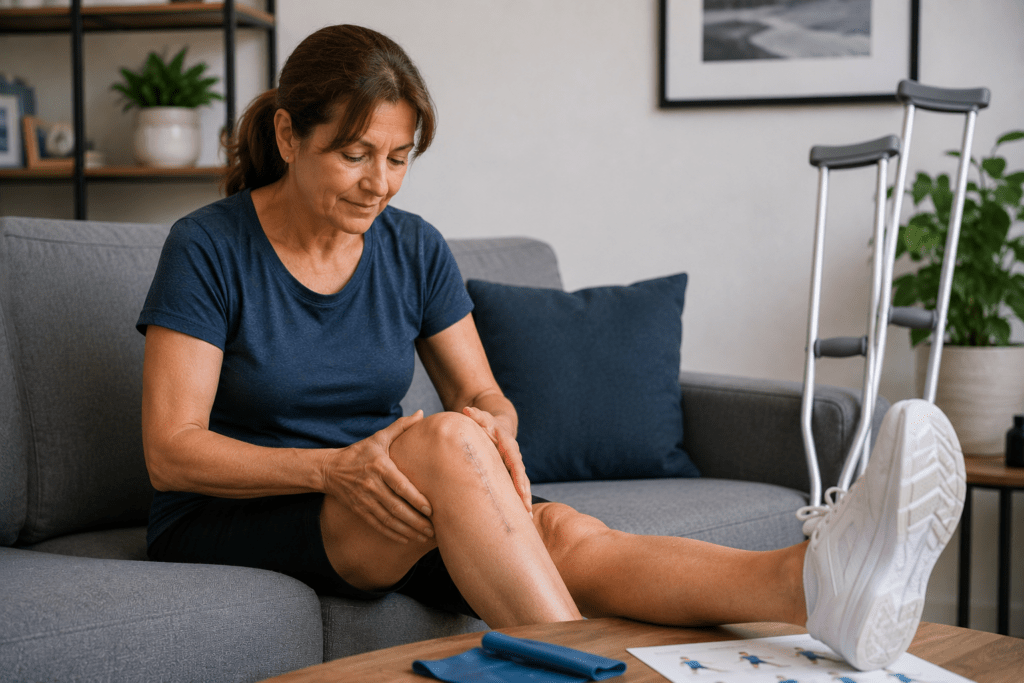
In the first 2 to 6 weeks following surgery, your knee will be swollen, warm to the touch, and bruised. Patients often panic, thinking this means something is wrong.
In reality, this is a completely normal, necessary inflammatory response. Your body is directing blood flow and healing factors to remodel the bone and surrounding tissues.
The Protocol to Control it:
- Elevation & Compression: Whenever you aren’t moving, your leg should be elevated with your ankle higher than your heart to let gravity drain the fluid.
- The Ice Strategy: Applying ice for 20 minutes at a time, several times a day, is proven to numb local nerve endings and temporarily reduce localised throbbing.
- The 24-Hour Pain Rule: Yes, you need to push the knee to regain movement, but if your resting pain spikes above a 5/10 into the next day, you have overloaded the healing tissues. Scale back the intensity of your walks and focus on gentle range-of-motion work.
2. Reclaiming Your Range of Motion: Bending and Straightening
Orthopedic literature highlights two critical milestones for a functional knee replacement: Extension (straightening the leg) and Flexion (bending the leg).
Extension (Goal: 0° perfectly straight)
This is the absolute priority in the first fortnight. If a knee heals with a minor permanent bend (flexion contracture), you will limp when you walk, which rapidly fatigues your lower back and hip.
- Evidence-Based Tip: Avoid placing a pillow directly under your knee when resting. While it feels comfortable, it keeps the joint bent. Instead, place the pillow under your calf or ankle to let gravity gently pull the knee into a straight position.
Flexion (Goal: 90° by week 6, progressing to 110°+)
You need approximately 65° of bend to walk normally, 90° to sit comfortably in a standard chair, and 105° to negotiate stairs smoothly. Regaining this bend requires consistent, gentle stretching—such as seated heel slides on a smooth floor—rather than aggressive, forced bending that causes the joint to flare up and swell further.
3. Why Walking Isn’t Enough (The Role of Quadriceps Inhibition)
A common mistake post-operative patients make is assuming that walking up and down their street or hallway is enough rehabilitation.
During surgery, the large thigh muscle (the quadriceps) experiences what literature calls Arthrogenic Muscle Inhibition (AMI). Essentially, because of the joint swelling and trauma, the brain temporarily “turns down the volume” on the nerve signals running to the quadriceps. The muscle literally forgets how to fire efficiently.
Walking with an inactive quadriceps muscle leads to a compensated, stiff-legged gait. To wake the muscle up, peer-reviewed clinical guidelines recommend targeted isometric and resistance exercises:
- Static Quads (Quad Sets): Squeezing your thigh muscle tight to push the back of your knee flat into the bed, holding for 5 seconds.
- Straight Leg Raises: Once you can lock the knee straight, lifting the entire leg a few inches off the bed to build hip and quad control.
- Seated Knee Extensions: Progressively strengthening the muscle through its full arc of movement against gravity.
4. Transitioning Back to Real Life in Colchester
By weeks 6 to 12, your walking frame or crutches are usually packed away, and you are looking to step back into daily life.
This is the phase where physiotherapy shifts from basic joint protection to functional capacity building. We focus on balance retraining, step-ups, and building the lower-body power required to confidently manage uneven terrain, steps, and longer distances.
Whether your ultimate goal is returning to the golf course, gardening in your back yard, or enjoying an active retirement across North Essex, your exercise program must match the real-world demands you intend to place on it.
Expert Post-Op Care at Reflex-18
You do not have to figure out your recovery alone, or rely on a generic sheet of exercises given to you at the hospital door.
At our Colchester clinic, we provide personalised, evidence-based post-operative care. We measure your joint angles, monitor your swelling patterns, and adjust your rehabilitation plan week-by-week to ensure you hit your milestone goals safely and with absolute confidence.