
If you have ever been told you have a “slipped, herniated, or degenerated disc,” you probably felt an immediate wave of anxiety. It sounds mechanical, permanent, and terrifying. Many people instantly change the way they move, stop going to the gym, and assume their spine is fundamentally broken.
But the way we talk about discs in the clinic is often entirely different from what the peer-reviewed medical literature actually shows.
Let’s look at the scientific realities of disc biology and deconstruct five of the biggest myths surrounding back pain.
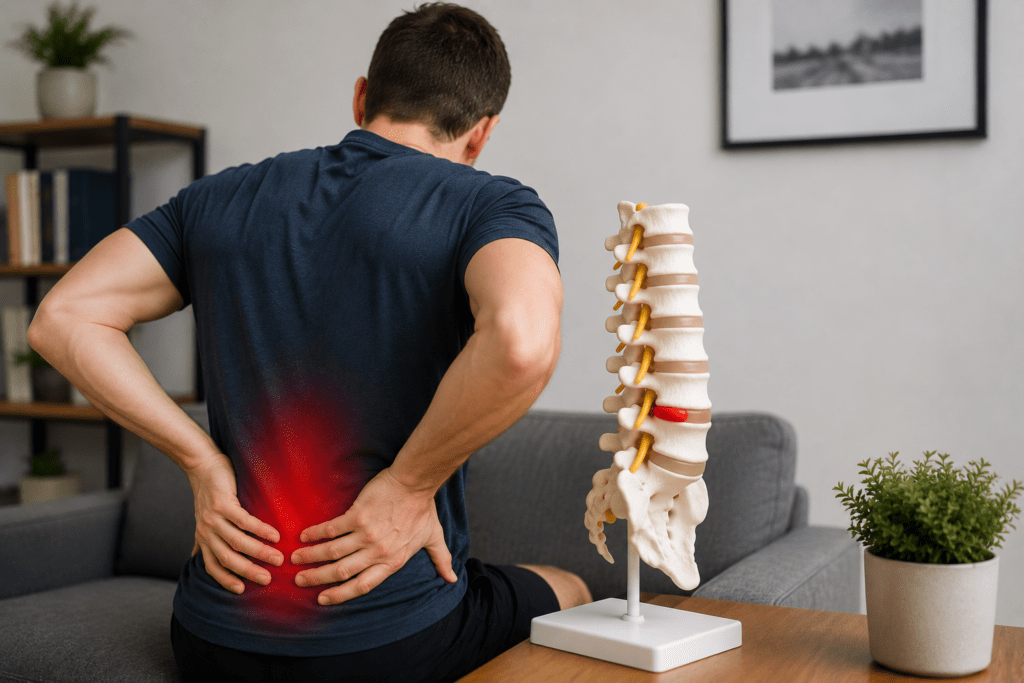
Myth 1: “Discs can literally slip out of place”
The Science: This is anatomically impossible. Your intervertebral discs are pads of incredibly tough fibrocartilage that separate your vertebral bodies. The outer layer, known as the annulus fibrosus, consists of roughly 20 concentric sheets of dense collagen fibers that are firmly embedded directly into the bone of your vertebrae.
A disc cannot “slip” out like a bar of soap in the shower. When a disc herniates or prolapses, it simply means some of the soft inner gel (the nucleus pulposus) moves outwards through the tough outer layers. The disc itself remains firmly locked in place within the spinal column.
Myth 2: “Disc degeneration is a rare, severe disease”
The Science: “Degeneration” is a scary medical term, but peer-reviewed data highlights that structural changes in the disc are a completely normal feature of getting older. In fact, structural changes can begin to develop in the intervertebral discs before the age of 20.
Over time, the nucleus loses some of its water-binding molecules, causing a natural drop in internal pressure. The disc naturally begins to lose height and bulge slightly outwards. Think of it less like a disease and more like getting “grey hairs on the inside.” It is an expected age-related adaptation, not a progressive spinal failure.
Myth 3: “If my scan shows a degenerated or bulging disc, that is the exact cause of my pain”
The Science: There is a surprisingly weak correlation between what an MRI scan shows and whether or not a person feels pain. The medical literature explicitly notes that disc degeneration is frequently not painful at all. Millions of people walk around Colchester every day with bulging or degenerated discs without realising it because they have zero symptoms.
Pain doesn’t automatically happen just because a disc changes shape. True discogenic pain usually only occurs if structural disruption (like a deep radial fissure) allows in-growing nerves to be chemically irritated and sensitised by local soluble inflammatory factors.
The Key Takeaway: Your scan results are not your destiny. You can have a significantly degenerated disc on an image and still live a completely pain-free, highly active life.
Myth 4: “A degenerated disc makes your spine unstable forever”
The Science: When a disc loses pressure and height, it can cause a temporary phase of minor “segmental instability,” which feels like a catch or a wobble in your back. However, the human body is incredibly intelligent at self-stabilizing.
The literature outlines that the mechanical stress of a bulging disc naturally stimulates the growth of bony overgrowths called osteophytes around the margins of your vertebrae. While people often panic when they see “bone spurs” on an X-ray, the science shows that these osteophytes actually restrict excessive bending to safely restore stability to the spinal segment. They are a purposeful, helpful, adaptive response by your body—not a structural failure.
Myth 5: “If you have disc pain, you need complete bed rest and surgery”
The Science: Landmark clinical trials have fundamentally shifted how we treat disc issues. Massive studies looking at spinal surgeries compared them to “sham” (placebo) surgeries and found that patients who didn’t actually have the structural decompression operation improved just as much as those who did.
Furthermore, complete bed rest is actively detrimental to a disc. All spinal bones and supporting tissues strengthen or weaken based on the mechanical demands placed on them. Total inactivity causes muscle wasting (sarcopenia) and rapidly reduces your bone mass (osteopenia) , making your spine less capable of handling daily life.
Modern peer-reviewed literature confirms that physical therapy treatments have a profound ability to accelerate the natural healing of a painful outer annulus. Movement delivers the essential mechanical signals required to settle nervous system sensitivity, distribute load evenly, and encourage tissue repair.
Reclaiming Your Confidence in Your Spine
Your back is not a stack of loose blocks waiting to fall out of alignment; it is an incredibly robust, deeply reinforced system designed to withstand forces up to five to ten times your body weight during heavy lifting.
If you have been diagnosed with a disc issue and have been avoiding the activities you love out of fear, it’s time to change the narrative.
At Reflex-18, our treatment plans are built strictly on modern, peer-reviewed biomechanical and physiological science. We focus on helping you safely load your spine, de-sensitise your nervous system, and build the physical capacity you need to move without fear.