
For runners, there is nothing quite like the frustration of training being interrupted by knee pain. Whether you are gearing up for a local event like the Colchester Half Marathon or simply enjoying your weekly laps around Castle Park, a sudden ache in or around the knee can quickly stall your momentum.
The two most common culprits behind non-traumatic knee pain in runners are Patellofemoral Pain Syndrome (Runner’s Knee) and Iliotibial Band Syndrome (ITBS). Because both conditions are triggered by repetitive loading and can feel similar during a run, they are frequently confused.
However, they are entirely different in where they hurt, what causes them, and how they should be managed. Relying on “complete rest” or the wrong rehab strategy can keep you off the road for much longer than necessary.
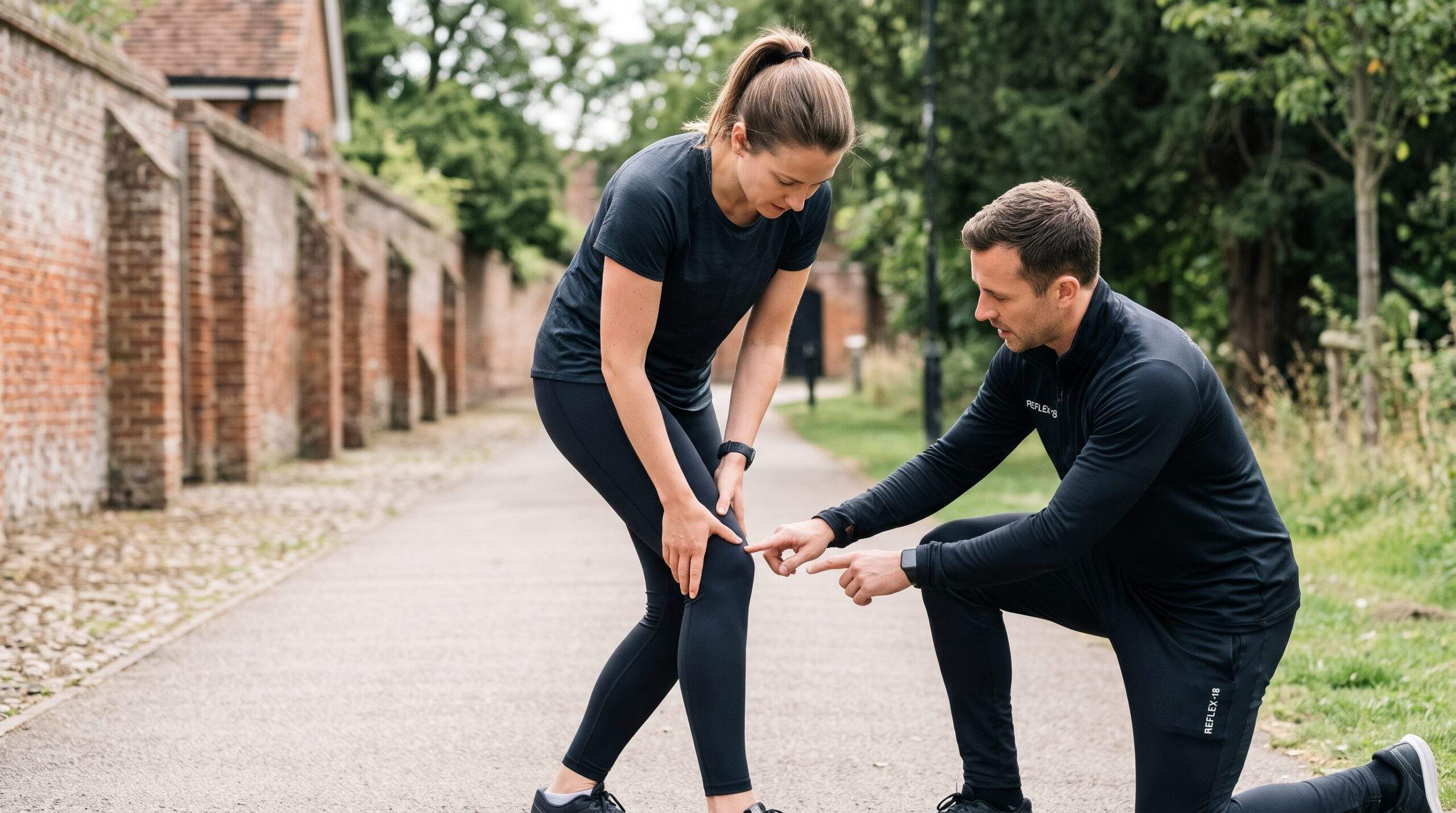
Here is how to tell them apart and what you can do to get back to running pain-free.
1. Patellofemoral Pain Syndrome (Runner’s Knee)
Runner’s Knee is essentially a load-management issue involving the joint where your kneecap (patella) meets your thigh bone (femur). It is frequently described as a “tracking” issue, but more accurately, it is an overload of the sensitive tissues around the patellofemoral joint.
- Where Does It Hurt? The pain is typically felt at the front of the knee, either directly behind, around, or just under the kneecap. It is often described as a dull, diffuse ache that is hard to pinpoint with a single finger.
- When Does It Hurt Most? It often aches during or after a run, but it is notoriously aggravated by stairs (especially going down), squatting, and sitting for long periods with your knees bent (sometimes called “theater sign”).
- What Does It Feel Like? A stubborn, throbbing ache. You might also hear or feel harmless grinding, clicking, or crunching (known as crepitus) when you bend and straighten the joint.
2. Iliotibial Band (IT) Syndrome
IT Band Syndrome is a compression and friction issue rather than a joint problem. The IT band is a thick, fibrous band of tissue that runs down the outside of your thigh, from your hip to just below your knee.
- Where Does It Hurt? The pain is highly localised on the outer (lateral) side of the knee, right where the band slides over a bony prominence on the thigh bone (the lateral femoral epicondyle). You can usually point to the exact spot with one finger.
- When Does It Hurt Most? Typically, the pain kicks in at a very predictable point during a run—often after exactly 10 or 15 minutes. It is especially aggravated by running downhill, where the knee bends at a specific “friction angle” of about 30 degrees.
- What Does It Feel Like? Unlike the diffuse ache of Runner’s Knee, ITB pain can feel like a sharp, burning, or stabbing sensation. It can become so intense that it forces you to stop running entirely and might cause you to limp when walking. It rarely hurts when you are just sitting.
The Comparison: Runner’s Knee vs. IT Band Syndrome
To help you tell them apart at a glance, consider how they compare:
| Feature | Runner’s Knee (Patellofemoral Pain) | IT Band Syndrome (ITBS) |
| Primary Pain Location | Front of the knee (behind/around the kneecap) | Outside (lateral) edge of the knee |
| Pain Description | Dull, diffuse ache | Sharp, localized, burning |
| Pinpoint Test | Hard to locate with one finger (“It’s just in there”) | Easy to point to one specific spot on the side |
| stairs & Hills | Worse going down stairs; squatting | Worse running downhill |
| Sitting/Rest | Aches after sitting with knees bent | Generally fine when sitting |
| Biomechanical Focus | Quadriceps strength, kneecap tracking, hip control | Gluteal control, hip drop, stride length |
The Shifting Science: Moving Beyond “Rest” and “Stretching”
In the past, the standard advice for both of these issues was simple: “Rest until it stops hurting, and stretch your IT band or quads.”
Modern sports medicine has moved far beyond this passive approach. First, you cannot “stretch” an IT band—it is an incredibly dense, non-elastic structure with the tensile strength of a car tire. Attempting to stretch it can actually increase compression on the sensitive tissues beneath it. Second, complete rest simply deconditions your muscles, making the knee even less capable of handling the impact of running when you eventually return.
Instead, evidence-based management focuses on load management and kinetic chain capacity:
- Manage the Load (The 4/10 Rule): You do not need to stop running entirely unless your pain is severe. Discomfort up to a 4/10 on the pain scale during or after a run is considered safe, provided it returns to your baseline within 24 hours. If it does, your body is adapting. If the pain spikes or lingers, you need to reduce your mileage or frequency temporarily.
- Build Hip and Gluteal Strength: For both conditions, weak hip and gluteal muscles can cause your thigh to rotate inward and your pelvis to drop when you land. Strengthening your gluteus medius and maximus (with exercises like clamshells, split squats, and lateral band walks) keeps your leg properly aligned, unloading both the kneecap and the IT band.
- Incorporate Targeted Quad Loading (for Runner’s Knee): To help your kneecap handle the force of running, you need to build the capacity of the quadriceps. Controlled, slow squats, step-downs, and leg presses are excellent for this.
- Adjust Running Technique: Sometimes, small adjustments can make a massive difference. For ITB pain, increasing your step rate (cadence) by 5–10% can reduce the stride length and lower the impact forces on the outside of your knee. Avoid running on heavily cambered (sloped) roads, which can increase stress on the outer knee.
Get Back to Running Strong with Reflex-18
If knee pain is interrupting your training or making you hesitant to get out on the road, waiting and hoping it will go away rarely works. Modern physiotherapy can identify exactly which tissue is protesting and help you build the specific capacity you need to run pain-free.
At Reflex-18 in Colchester, our specialist physiotherapy team provides comprehensive running assessments. We analyse your gait, test your hip and knee strength, and design a progressive rehabilitation and strength program tailored specifically to your goals and your stride.