
If you get a dull, aching pain right around or behind your kneecap when walking down stairs, crouching to pick something up, or sitting for an hour at your desk, you are dealing with one of the most common issues we treat in clinic.
For decades, patients with front-of-knee pain were told that their kneecap was “tracking badly” or rubbing against the bone because of muscle imbalances. You might have been given a knee brace or told to stop squatting altogether.
However, modern sports medicine and physical therapy literature has completely redefined how we look at front-of-knee pain—now formally known as Patellofemoral Pain Syndrome (PFPS).
The latest peer-reviewed research proves that your kneecap isn’t permanently “misaligned.” Instead, your knee is simply experiencing a load-tolerance issue. Here is what the science actually says, and how to fix it for good.
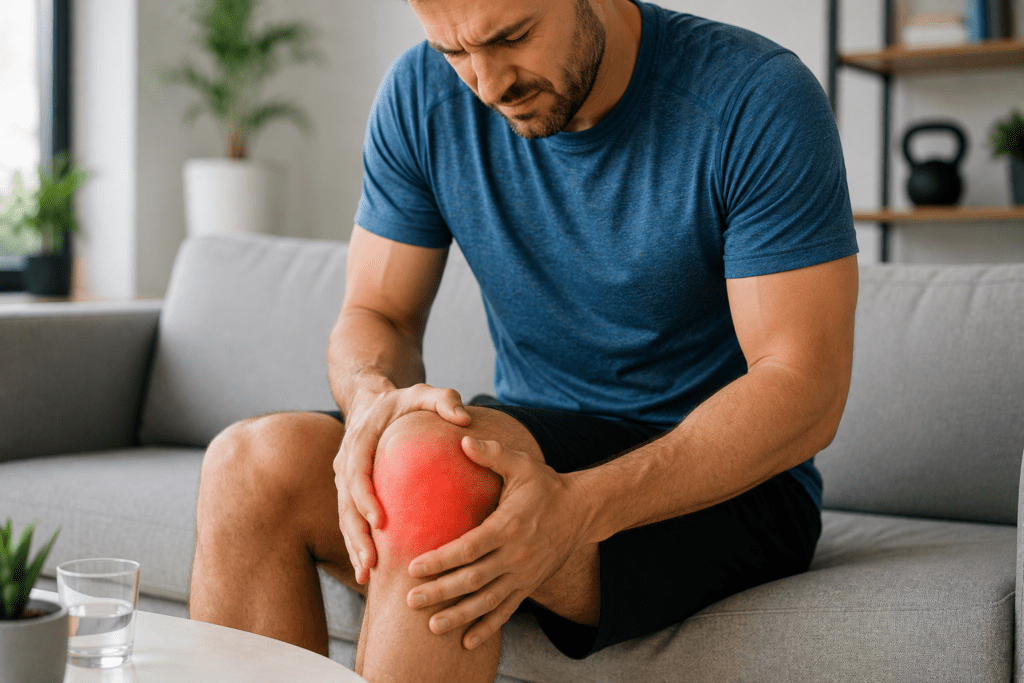
The Shift in Science: It’s About Stress, Not Just Structure
Your kneecap (patella) sits inside a groove at the front of your thigh bone. Every time you bend your knee under load—like running down a hill at Park run or doing lunges at the gym—the kneecap presses into that groove to distribute force.
The old theory suggested that if your outer thigh muscles were tighter than your inner thigh muscles (the VMO), the kneecap would pull to the side, wearing down the cartilage.
However, large-scale biomechanical studies using real-time imaging have shown that many people with perfectly “straight” tracking experience severe knee pain, while others with “poor” tracking run marathons with zero issues.
The consensus in current sports medicine literature (such as the International Patellofemoral Pain Research Consensus) highlights that PFPS is driven by tissue overload. The nervous system and the subchondral bone behind the kneecap have become highly sensitive because the mechanical stress placed on the joint has temporarily exceeded what the tissues are trained to handle.
3 Classic Signs of Patellofemoral Pain Syndrome
If your knee pain fits the PFPS profile, you will likely recognize these symptoms:
- The “Movie Goers Knee” Sign: Your knee deep-aches or throbs after sitting with your knees bent for a long period (e.g., during a long drive on the A12 or sitting at an office desk).
- The Descent Struggle: Walking down stairs or down steep hills causes a significantly sharper pinch or ache than walking up them.
- The “Warm-Up” Effect: The knee might feel incredibly stiff and cranky when you first start a walk or a workout, but it gradually desensitizes and feels better as you move, only to ache later that evening.
What Does the Literature Say About Treatment?
Because front-of-knee pain is a capacity issue rather than a structural deformity, resting it completely is the worst thing you can do. Complete rest reduces the strength of your quadriceps and degrades the load-bearing capacity of your cartilage, making the knee more sensitive when you try to return to activity.
According to a comprehensive systematic review published in the British Journal of Sports Medicine (BJSM), the gold-standard treatment consists of targeted, progressive loading:
1. Proximal and Local Strengthening (The Hip-Knee Connection)
The research is definitive: to fix a knee, you have to strengthen the hip. When your glutes and hip external rotators are strong, they control how your entire leg moves underneath you. Combining hip-strengthening exercises (like side-lying clams or heavy glute bridges) with knee-strengthening exercises (like slow, controlled leg presses or wall sits) has been proven to reduce knee pain far faster than focusing on the knee alone.
2. Finding Your Baseline (The 4/10 Rule)
You do not need to wait until your knee is 100% pain-free to exercise. We use the clinical 0–10 pain scale to guide your recovery. If your knee discomfort stays under a 4/10 during movement, doesn’t cause you to limp, and returns to its baseline by the next morning, the exercise is actively helping your joint adapt and heal.
3. Cadence and Biomechanical Adjustments
For local runners or walkers struggling with knee pain, simple shifts can make a massive difference. Increasing your running cadence (taking slightly shorter, quicker steps) by just 5% to 10% has been structurally proven to reduce the peak impact force traveling through the patellofemoral joint by up to 20%.
Stop Waiting for it to “Clear Up”
Front-of-knee pain is notoriously stubborn when ignored, often causing people to gradually drop out of the sports and activities they love.
At Reflex-18, we don’t give you generic leg extension sheets or tell you to just wear a support sleeve. We look at your hip stability, your foot mechanics, and your current training load to design an evidence-based, progressive rehabilitation plan that builds true tissue resilience.