
For adults over 50, few phrases sound as daunting as “bone-on-bone” or “degenerative changes.” When a persistent ache develops in your groin, your lower back feels constantly locked, or putting on socks in the morning begins to feel like an Olympic sport, it is easy to assume your hip joint is simply wearing away like the tread on an old tyre.
The natural reaction to that diagnosis is often fear: If my joint is wearing out, shouldn’t I rest it to save what is left?
Modern musculoskeletal medicine offers a clear, reassuring answer: no.
Treating hip osteoarthritis like an engine part that needs to be parked accelerates the problem. Your joints are living,dynamic biological systems designed to adapt. Understanding how joint nutrition works reveals why movement isn’t grinding down your hip—it is the very thing keeping it alive and functional.
The “Bone-on-Bone” Myth: What the Scans Don’t Tell You
The phrase “bone-on-bone” is one of the most misunderstood descriptions in orthopaedics. It often creates a mental picture of jagged surfaces scraping against each other, causing people to guard their movement, limp, or avoid walking altogether.
However, clinical research repeatedly shows that structural changes seen on X-rays or MRIs correlate poorly with day-to-day pain and mobility. Millions of people walk, cycle, and hike with substantial joint narrowing on their scans and feel zero pain, while others with minimal visible changes experience significant stiffness.
Osteoarthritis is not an inevitable, passive wear-and-tear process. It is an active joint-remodelling condition influenced by inflammation, muscle strength, and movement habits. When you stop moving out of fear, the joint capsule tightens,surrounding muscles lose mass, and the hip becomes significantly more sensitive to everyday tasks.
Why “Motion Is Lotion”: How Cartilage Feeds Itself
Unlike muscle, bone, or skin, articular cartilage does not have its own direct blood supply. It cannot rely on the bloodstream to deliver oxygen and nutrients or flush out metabolic waste.
Instead, cartilage relies entirely on synovial fluid—the natural, viscous lubricating fluid inside your hip capsule. The delivery mechanism is a biological process called fluid imbibition, which works like a sponge:
- When you bear weight (during a step or pedal stroke), the cartilage compresses, squeezing out waste products.
- When you unload the joint, the cartilage expands, drawing in fresh synovial fluid packed with nutrients and oxygen.
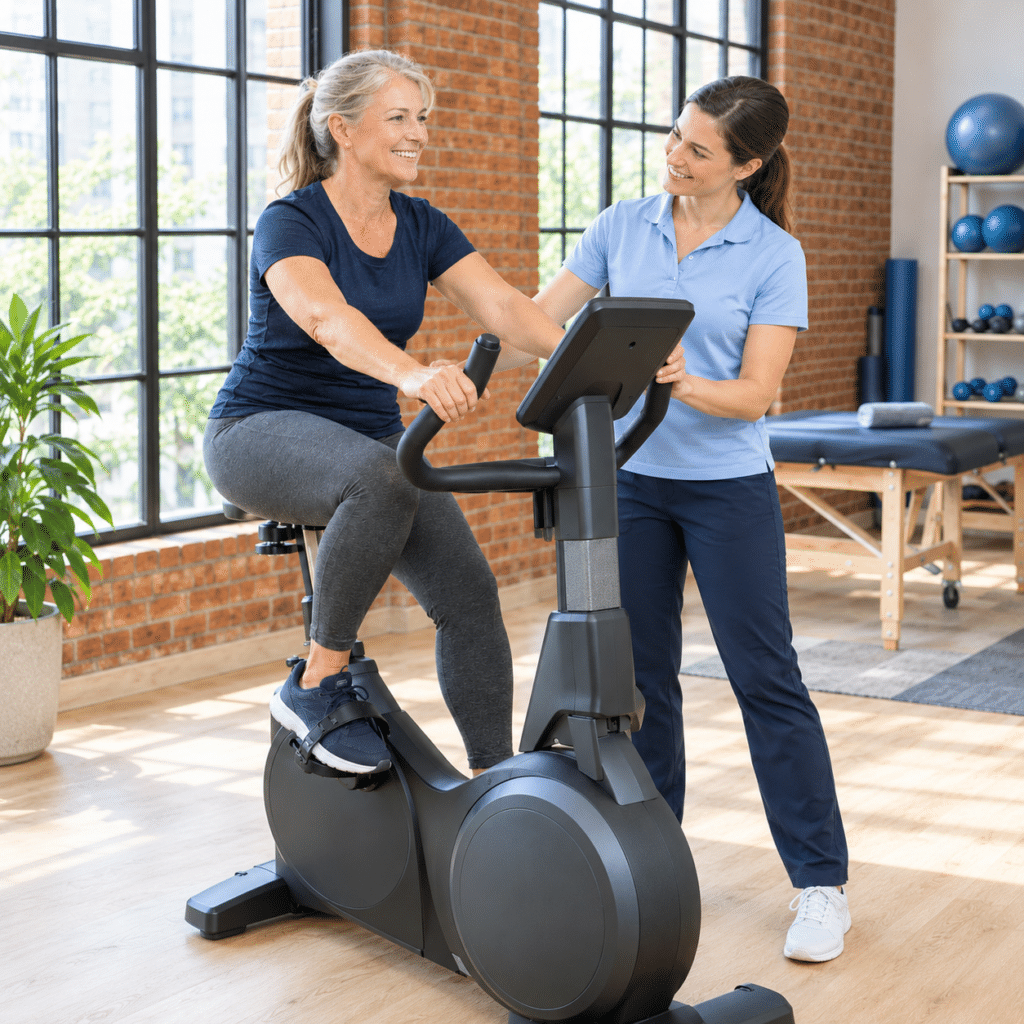
This cyclic loading and unloading is the only way your hip cartilage stays nourished and hydrated. Low-impact, rhythmic movement—such as brisk walking, stationary cycling, or swimming—literally pumps lubricating fluid through the joint capsule, easing morning stiffness and restoring smoother movement.
3 Signs of Early Hip Stiffness to Address Early
- The “Sock Struggle”: Difficulty bending down, rotating the leg outward, or reaching your feet to put on shoes and socks in the morning.
- Groin or Deep Buttock Ache: Discomfort that settles deep in the front crease of the hip or wraps into the buttock,often feeling worse after sitting for long periods.
- Loss of Internal Rotation: Feeling a distinct “block” or stiffness when trying to turn your knee or foot inwards compared to the other side.
Muscular Shock Absorbers: Unloading the Joint Space
If the joint space has narrowed, how do you prevent excess mechanical stress on the bone? By building stronger muscular shock absorbers.
Your hip joint is surrounded by powerful muscle groups:
- The Gluteus Maximus & Medius: Control pelvis stability and absorb ground impact during walking and climbing stairs.
- The Quadriceps: Dampen landing forces as your foot strikes the floor.
- The Hamstrings: Decelerate movement and stabilize the hip-pelvis interface.
When these muscles are strong and active, they absorb the vast majority of peak impact forces that would otherwise pass directly through the hip joint. Strengthening these surrounding muscle groups actively unloads the joint space, improves walking tolerance, and can significantly delay—or even eliminate—the need for hip replacement surgery.
Practical Movement Strategies for Hip Osteoarthritis
- Use the 4/10 Symptom Rule: Experiencing mild, familiar discomfort up to a 4/10 on the pain scale during or after low-impact exercise is safe, provided it settles back to your normal baseline within 24 hours.
- Embrace Low-Impact Cardio: 15–20 minutes of smooth pedalling on a stationary bike or walking on flat surfaces lubricates the hip without spike impact forces.
- Pace, Don’t Stop: Break long periods of static sitting with gentle hip-mobility snacks: standing hip extensions,gentle seated knee lifts, or standing weight-shifts.
Protect Your Mobility at Reflex-18
Hip stiffness doesn’t have to dictate your independence or stop you from enjoying your daily walks around Colchester. Complete rest and avoiding activity only lead to weaker muscles and stiffer joints.
At Reflex-18, our physiotherapy team specialises in targeted mobility assessments and individualised strength programs. We help you rebuild the muscular shock absorbers around your hip, restore joint fluid dynamics, and regain the confidence to move without fear.