
It is a moment that immediately causes panic for any gym-goer, manual worker, or active adult: a sudden “pop” or tearing sensation in the front of the arm, followed by sharp pain, swelling, and eventually, a distinct bruising that pools near the elbow.
A bicep tear—whether it occurs at the shoulder (proximal) or the elbow (distal)—is a significant injury. Because the biceps muscle is highly visible and essential for lifting, pulling, and bending the arm, people often fear that a tear means permanent weakness, a forever-altered arm shape, or an inevitable need for surgery.
Modern sports medicine and rehabilitation science offer a highly reassuring path forward. While a bicep tear is undeniably a major setback, your body’s ability to adapt and recover is remarkable. Understanding the difference between tear types, natural healing timelines, and how to safely rebuild capacity is the key to regaining full function.
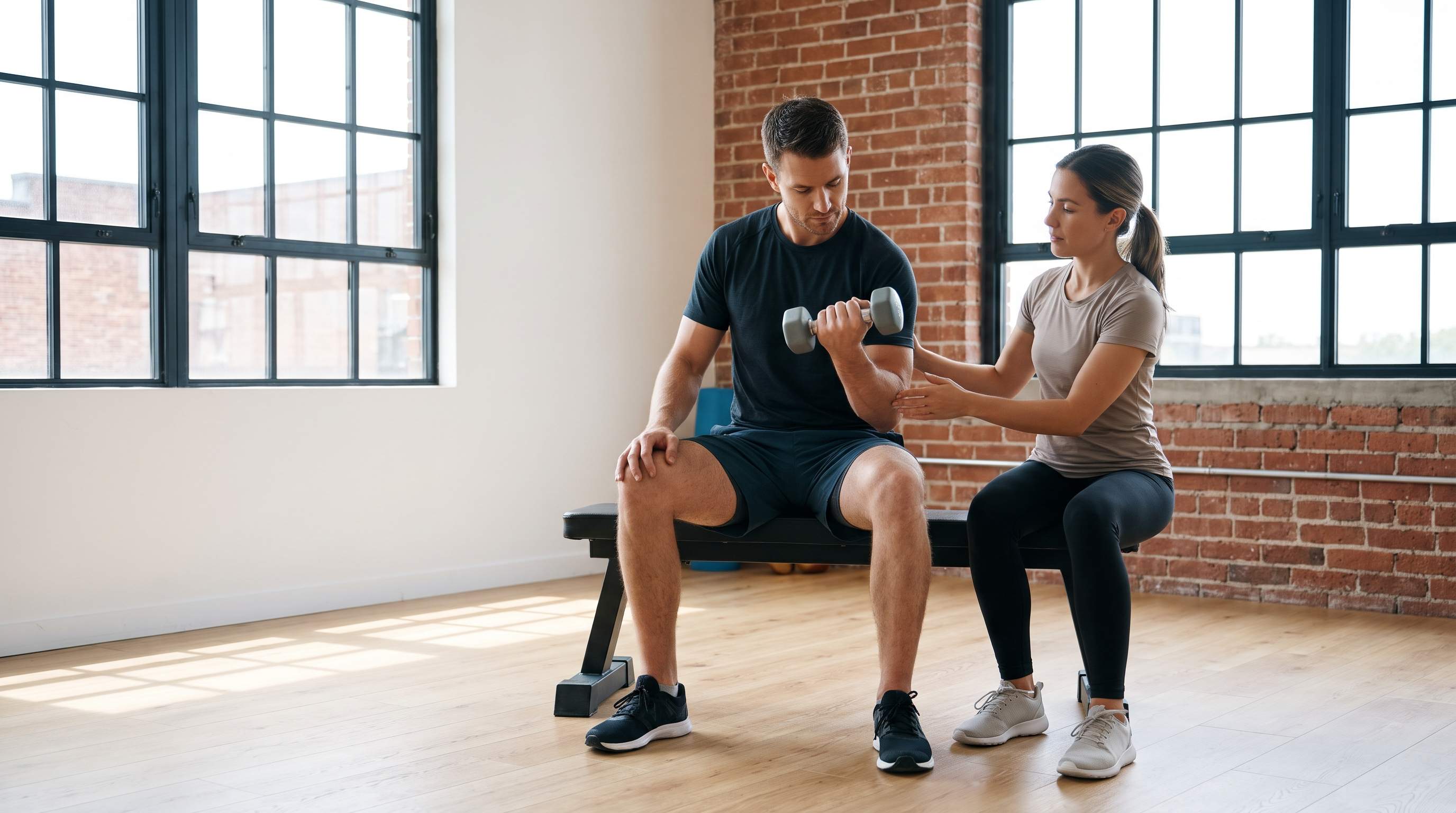
Proximal vs. Distal: Not All Bicep Tears Are the Same
Your biceps muscle has two tendons at the top (attaching to the shoulder) and one tendon at the bottom (attaching to the elbow). Where the tear occurs entirely changes how it is managed:
1. Proximal Bicep Tears (The Shoulder)
This is the most common type, often involving the “long head” of the biceps tendon. It frequently occurs in older adults due to gradual wear and tear, or in lifters during overhead or throwing movements.
- The “Popeye” Muscle: When this tendon tears completely, the muscle belly can bunch up lower down the arm, creating a prominent bulge.
- The Good News: Because the “short head” of the biceps remains firmly attached, the shoulder and arm retain the vast majority of their strength. For most people, non-operative rehab is highly successful.
2. Distal Bicep Tears (The Elbow)
This occurs where the bicep tendon attaches to the forearm. It usually happens during a sudden, heavy lifting or catching event—such as dropping a heavy object, lifting a barbell, or catching a falling load.
- Why It’s Different: Because this is the only attachment at the elbow, a complete distal tear significantly impacts your ability to bend the arm (flexion) and twist the forearm (supination, like using a screwdriver).
- The Management: Complete distal tears, especially in active or manual-working individuals, are often considered for surgical repair to preserve full twisting power, while partial tears or less active individuals can often be managed successfully without surgery.
The Recovery Timeline: What to Expect
Bicep recovery isn’t a race; it follows biological tissue-healing timelines. Here is a general outlook of what to expect during rehabilitation:
- Phase 1: Protection and Calming (Weeks 1–2): The primary focus is managing pain, swelling, and protecting the tissue as the initial inflammatory response settles. You may use a sling briefly, but gentle, pain-free movement of the hand, wrist, and shoulder is encouraged to prevent stiffness.
- Phase 2: Restoring Range of Motion (Weeks 3–6): Once the sharp pain subsides, we gradually restore your arm’s ability to straighten and bend fully. Active-assisted movements help gently stress the healing fibers without overloading them.
- Phase 3: Progressive Resistance (Weeks 6–12): This is where “load management” becomes crucial. We introduce light resistance—such as isometric holds (holding a weight without moving) and progress to slow, controlled bicep curls and pulling movements.
- Phase 4: Return to Sport & Heavy Lifting (Month 3+): Rebuilding dynamic strength, power, and endurance. For non-operative or surgically repaired biceps, returning to heavy lifting or manual labor typically occurs around the 3-to-6-month mark once equal strength is restored.
3 Red Flags to Watch For After an Arm Injury
- Visible “Bulging” or Deformity: A sudden, unusual bunching of the bicep muscle further down the arm.
- Inability to Twist the Forearm: Significant weakness or pain when trying to turn your palm upward (supination).
- Significant Deep Elbow Pain: Sharp, persistent pain in the front of the elbow crease following a lifting incident, accompanied by bruising.
What the Literature Says About Non-Operative vs. Surgical Rehab
Modern orthopedic research shows that for many proximal bicep tears, conservative (non-surgical) rehabilitation achieves excellent functional results. Over time, the surrounding muscle groups—such as the brachialis and supinator—adapt to compensate for any lost bicep capacity, restoring almost all of your original lifting and pulling power.
- Strengthen the Compensators: Exercises targeting the forearm, shoulder, and upper back help distribute forces evenly, taking the pressure off the healing tendon.
- Gradual Graded Loading: Applying progressive, pain-free strain is the only way to rebuild the tensile strength of the tendon and muscle fibers. Rest is needed initially, but prolonged immobilisation leads to weakness and joint stiffness.
- Follow the 4/10 Rule: As you resume lifting, experiencing mild discomfort up to a 4/10 on the pain scale is safe, provided it settles back to your normal baseline within 24 hours.
Rebuild Your Strength and Confidence at Reflex-18
A bicep injury can feel incredibly limiting, but passive rest won’t rebuild your lifting capacity. Whether you are managing a tear conservatively or recovering post-surgery, a structured, expert-led rehabilitation program is essential to get your arm back to 100%.
At Reflex-18 in Colchester, our specialist physiotherapy team provides comprehensive assessments to analyse your arm’s strength, restore full joint mobility, and design a progressive strength program tailored to your daily demands, gym goals, or workplace needs.