
You know what I mean right? Sitting in the physio clinic having had a diagnosis and now being shown your exercises. The thought going through your head is; ‘am I really supposed to do that in the gym where everyone can see?’.
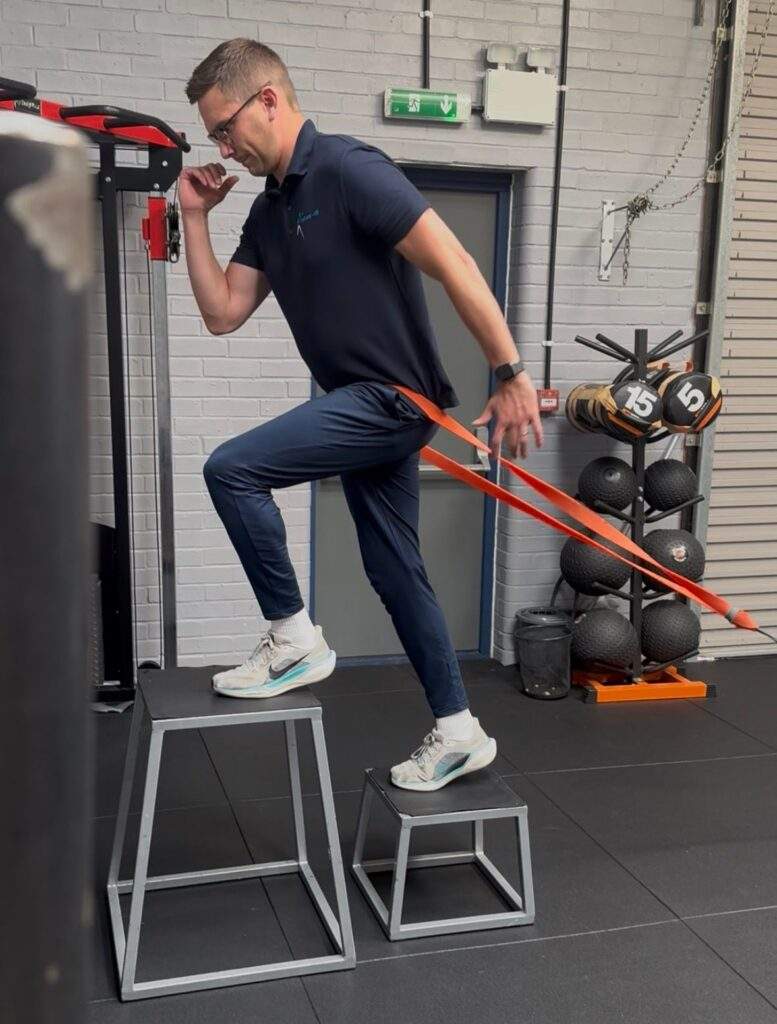
When you go to the gym, you can often spot those people exercising who have seen a physio as often they will be doing something away from the normal and regularly will involve a yellow or red band. But seeing others do it doesn’t make it easier to do ourselves.
So why do physios give such unusual exercises? I’ll tell you.
Most gym programs and body building centric
When you Google ‘gym programs’ or use an online or face to face coach, what you usually get is a body building focussed program. People are often attending the gym to lose weight and look better in the mirror. When these are the goals, a body building program style program is often the right choice as it is focussed around growing muscles (hypertrophy) which will increase the metabolic demand from your body (to feed the extra muscle) and therefore help you lose weight and look toned.
Since this is historically how people trained in the gym and the main focus for people, this seems to be where there is a huge amount of advice and guidance for. These workouts will include a combination of machines, which are simple for a novice to use and dumbbells/barbells which can sometimes be more challenging. But everyone in the gym is doing them, so they look normal.
The problem with gym training
The issue sometimes with gym training, is that a critical component of progress in the gym is the principle of progressive overload. That is the need to gradually push harder to progress. This can come in the form of increased reps, sets or most commoly weight.
This is vitally important and should be encouraged. However, this issue can sometimes arise that if you are lifting heavy weight, but aren’t moving particularly well, perhaps because of that old knee injury that you never fully rehabbed – you wont be loading your body uniformly, and something that shouldn’t, will have to take the load.
At light weights, this doesn’t matter too much usually, but as the weight increases, you start to feel the strain and can end up with pain that stops you training.
Why do some people not move as well as others?
This is an important point and I feel there are 2 major answers:
- Movement literacy – This is a big one. If people exercise a lot when they are younger, engaging in different types of exercise. They learn different movement patterns, these patterns can be remembered and pieced together to then form different, or more complex patterns. The more experience people have of movement, particularly when young, the better they become at learning new movements, and the opposite is true too. Someone who has not performed a lot of varied movements previously will find it more difficult to pick up new movement patterns.
- Previous injury – When you have pain, quite often the pain settles, and you crack on with life without fully recovering. But your nervous system doesn’t forget. That pain becomes a memory for it, and something that it will avoid because it is trying to protect you. This happens subconsciously and your nervous system needs to be reassured and taught to allow movement again.
So why the stupid exercises?
What your physio is trying to do, is put your body in a position where it has no choice but to move in the way we want it to – it can’t compensate. This requires movements away from body building style exercises and will often involve some slightly different equipment – and a lot of shaking!
These exercises make the movement happen and provides reassurance to the nervous system that is OK to do, that it doesn’t need to be scared. By building this up, your physio will help you move better and distribute the load better. This creates a solid foundation to the build strength and resilience.
Don’t go too hard and too fast
So if you are new to the gym, or finding that you are going round in circles with injury. Take a step back, try not pushing the weights so hard, and take your routine back to basic movements, consider old injury sites and how those areas of your body move, and don’t be scared to do something different to others in the gym – after all, we are all different.